
Programs
General
Undergraduate studies in our department are towards a BSc in Chemical Engineering or a BSc in Biochemical Engineering, the latter is a joint course with the Biology Department at the Technion.
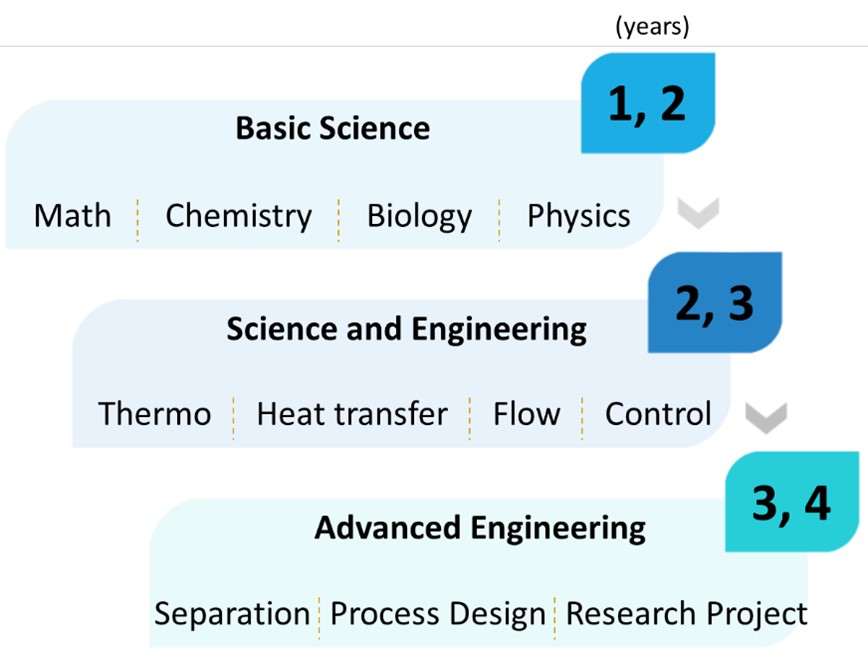
First year courses focus on basic scientific knowledge, the next two years are primarily devoted to learning engineering courses, and at the last year students learn to integrate the acquired knowledge and experience. In the last two years students choose from a variety of elective courses.
Chemical Engineering
The Chemical Engineering program primarily focuses on process engineering for design and optimization of a wide range of products and processes. Studies in this program combine engineering courses with a string scientific foundation. Chemical Engineering is a practical engineering program that trains students to apply scientific knowledge to design useful products and processes. Students can choose a major field: processes, materials, environmental technologies, science and engineering, micro and nano-technology, biochemical processes, and a general major.
Biochemical Engineering
The Biochemical Engineering program combines science and engineering, like the Chemical Engineering program, and adds a strong emphasis on Biology. In the Biochemical Engineering program students acquire additional knowledge and laboratory experience in various biochemical topics (metabolic pathways, genetics, gene control, microbiology, “wet” laboratories, and more).
Four-Year Combined Degree Program in Chemical Engineering and Chemistry
This program brings together all required coursework in Chemical Engineering and Chemistry within a single four-year degree. Graduates are trained as process engineers, or chemical engineers, while also acquiring broad and in-depth knowledge across the major fields of chemistry.
The study of process industries at the Faculty of Chemical Engineering integrates engineering principles ranging from fundamental physics, mass and heat transfer, fluid flow, and thermodynamics to the design and control of complex processes covered in advanced engineering courses.
Since most manufacturing processes involve various aspects of chemistry, every chemical engineering student must acquire a solid foundation in the field. Today, this foundation is equivalent to approximately one-third of the required coursework in the Technion’s Faculty of Chemistry. The combined degree in Chemical Engineering and Chemistry provides students with substantially more advanced knowledge of chemistry than is offered in the standard Chemical Engineering program.
This broader academic foundation gives graduates a significant advantage in the process industries, equipping them to address and develop complex manufacturing processes that require an understanding of advanced chemical and physical reactions and the ability to integrate them into production systems. This challenge is becoming increasingly common as technology advances rapidly in the electronics, energy, and defense industries, as well as in pharmaceutical manufacturing, which involves increasingly complex molecules, and in efforts to address environmental damage in the modern world.
The program is also designed to support the growing number of startup companies developing products based on complex chemical technologies.
Register to a BSc in Chemical or Biochemical Engineering at the Technion